
 Available in US
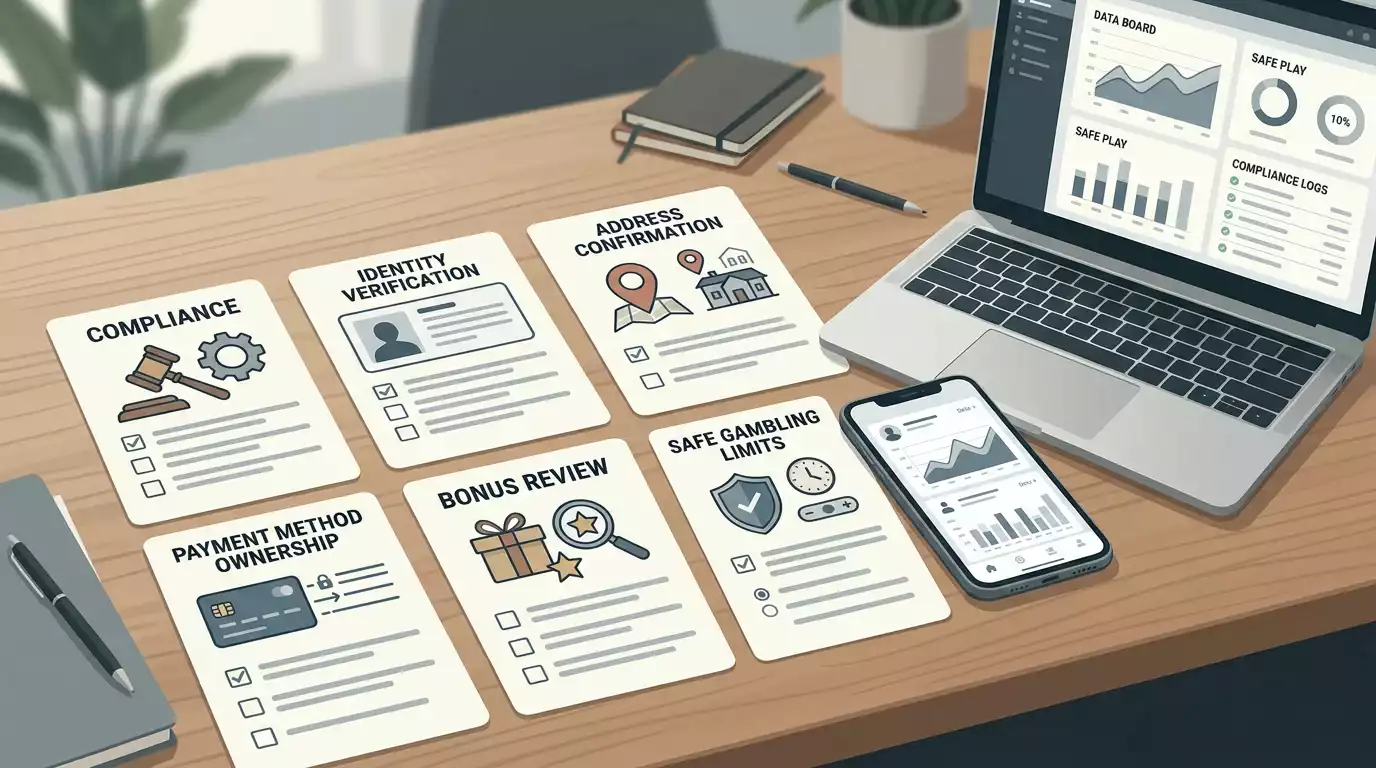
This checklist helps UK readers review eligibility, documents and safer-gambling controls before treating any FatBet account route as usable.
What should UK readers check before trying to register?
UK and GB readers should treat FatBet registration as unconfirmed. The live site must confirm country support for the exact account route being used. No current Gambling Commission entry for FatBet surfaced during the review, and operational UK acceptance remained unverified. KYC or document checks may be requested before deposits or withdrawals, including identity, address and payment-method ownership checks. This page is therefore a pre-registration checklist, not a sign-up flow or an account-approval promise.
The useful question is not simply “can I create an account?” It is whether the current site, terms, licence context, cashier, document process and safer-gambling tools all make sense before any personal details or funds are committed. The main FatBet guide gives the full evidence-led review position; this page focuses only on registration and KYC.Account caveats to keep visible
UKGC licenceA FatBet UK Gambling Commission licence was not verified during research, so this page does not call the brand locally licensed or UKGC authorised.UK or GB registrationOperational acceptance for UK or GB readers was not directly confirmed from visible official general-account text.KYC timingDocument checks may affect deposits as well as withdrawals. Do not assume verification happens only after a payout request.Support channelsSources indicate support channels and document-handling contact routes, but current channels should be rechecked on the live site before sending personal documents.
Account evidence status
| Checkpoint | Evidence position | Practical action |
|---|---|---|
| Country eligibility | Not directly verified as guaranteed for UK or GB readers. | Read the current country terms and compare them with the UK availability caveat. |
| Local licence context | UKGC licensing for FatBet was not verified. | Check the Gambling Commission public register before treating the account route as suitable for Great Britain. |
| Identity documents | Sources indicate that identity and account verification can be requested. | Have a current ID, proof of address and matching account details ready before considering a deposit. |
| Payment ownership | Payment-method ownership checks are a realistic KYC issue. | Use only methods in your own verified name and check the FatBet payment checks before funding an account. |
| Withdrawal readiness | Document requests can delay or block payouts when details do not match. | Read the withdrawal due diligence page before treating a deposit as reversible. |
Use a verification-first order
Many casino registration pages present the account form as the first step. For FatBet, the safer order is reversed. Start by checking the evidence, then check the account route, and only then decide whether the form is worth using. That order matters because availability, licence, cashier and KYC evidence are not the same thing.
A website can display an account form without proving that every country, payment method or withdrawal route is supported. A cashier can display a familiar currency without proving that the account will pass document checks. A bonus page can look current while the terms still restrict country, game type, payment method or verification status. Registration is just the beginning of the risk check, not the end.
For UK readers, the regulatory context adds another layer. Great Britain-facing remote gambling operators need appropriate Gambling Commission licensing. That general rule does not prove FatBet accepts or rejects UK readers, but it does mean the register and current terms should be reviewed before any account is treated as safe to use.
KYC documents to prepare without assuming approval
The research supports cautious wording that identity and payment-method verification may be required. It does not support a no-KYC claim, anonymous play claim, instant-approval claim or guaranteed payout claim. A practical reader should prepare for checks that confirm who the customer is, where they live and whether the payment route belongs to the same person.
Typical document categories to think about are a government identity document, a recent address document and evidence that the deposit or withdrawal method is held in the same name as the casino account. The exact accepted document types, upload route, review time and rejection rules must come from current FatBet terms or support, not from a generic casino checklist.
The non-generic insight is that KYC is not only an identity hurdle. It can join together country eligibility, payment ownership, bonus eligibility, withdrawal route and safer-gambling review. If the name, address, date of birth, country, phone number or payment owner is inconsistent, the account can become harder to verify precisely when the reader wants to withdraw.
Questions to ask before entering personal details
- Does the current site confirm your country or territory in plain account terms?
- Does the operator appear on the Gambling Commission public register under a business name, trading name or domain relevant to FatBet?
- Does the registration form explain age, identity, address and account-ownership checks before submission?
- Does the cashier show methods that are compatible with your verified country and current payment restrictions?
- Does the bonus page state country eligibility, wagering, excluded games and withdrawal restrictions before deposit?
- Can support point to written terms for KYC, document upload, withdrawals and rejected payments?
- Are financial limits, cooling-off tools and self-exclusion routes visible before the first deposit?
- Can you complete the same checks on the device you would actually use, including the FatBet mobile experience?
Support and document-handling checks
Support matters most when registration and withdrawals become uncertain. Sources indicate live chat or round-the-clock support and list document-related contact routes, but this page does not treat those leads as a guarantee of response time, jurisdiction coverage or document approval. Check the current support page, use only the official domain, and avoid sending documents to an address copied from a review page unless the live site confirms it.
Ask precise questions. “Can I register?” is too vague. Better questions are: which country term applies to my account, where are the KYC rules written, what documents are accepted, can I verify before depositing, which payment methods can withdraw, and what happens if a document is rejected? A useful support answer should point to current written rules, not just reassure you that everything is fine.
Record the evidence before moving on. Save the support reply, the page URL, the date, the country wording, the document route and any cashier note that affects withdrawals. This is not about creating a complaint file in advance; it is about avoiding vague memories later. If the account is reviewed after a deposit, a clear record helps distinguish what was shown before registration from what appeared only after the account was funded.
Also check whether support can explain what happens to rejected documents. A transparent process should say whether the account can correct errors, whether a payment method can be changed, and whether withdrawals are paused while documents are reviewed.
Safer-gambling checks at account stage
Account creation should include control, not only access. Current GB safer-gambling rules for licensed operators include prompts for customers to set financial limits before the first deposit and tools to review or change limits. That does not verify FatBet’s own tools, because FatBet’s UKGC licence and GB-facing compliance were not verified. It does explain what a UK reader should look for when judging the account journey.
A registration page should make it easy to find limits, time-outs, cooling-off options, account history and self-exclusion information. Licensed remote operators are also expected to use customer interaction systems and monitor harm indicators such as spend, time, behaviour, customer contact, use of gambling-management tools and account signals. Treat those ideas as a checklist for the account environment, not as a FatBet-specific compliance claim.
Use the FatBet safety review for wider trust checks and the GAMSTOP and safer gambling page if self-exclusion or loss of control is relevant. Registration should never be framed as a workaround for a self-exclusion decision.
When not to continue
Do not continue with registration if the country terms are unclear, if the domain is uncertain, if support cannot confirm written KYC rules, if the cashier is visible but withdrawal rules are not, or if a bonus pushes urgency before verification. Also stop if the account process encourages borrowed-money gambling, credit-funded e-wallet use, or play while self-excluded.
The practical decision rule is simple: if the account route cannot be explained in writing before money is deposited, the account route is not clear enough. A conservative pause is more useful than a fast registration that creates document, payment or withdrawal problems later. Keep notes of the domain, date, support answer and terms checked, because those notes are useful if an account dispute later develops.
It is also reasonable to abandon the process if the account journey feels inconsistent between desktop and mobile. A registration flow should not make core terms visible on one device but hide them on another. Consistency across devices helps a reader spot changes, redirects and unsupported claims before sensitive information is submitted.
Frequently asked questions
Can UK readers register at FatBet?
This research did not directly verify guaranteed UK or GB account acceptance. Check the live country terms, the exact domain and the Gambling Commission public register before treating registration as available.Does FatBet require KYC?
Expect possible KYC and payment-ownership checks. This page does not claim no-KYC, instant approval or guaranteed withdrawals. Current document rules should be checked in the live terms or support channel.Should I deposit before verifying documents?
Not if the terms are unclear. A cautious UK reader should understand country eligibility, document requirements, payment ownership, withdrawal routing and safer-gambling tools before depositing.
Privacy Policy | Cookie Policy | About This Guide
See also: visit fatbet casino for easy account management.
See also: learn how to cash out your winnings in our withdrawals guide.
Created by the "FatBet UK Guide" editorial team.