Is FatBet Casino Safe? Trust, Reputation and Complaints
 Available in GB
FatBet safety cannot be reduced to one score. A UKGC licence was not verified, third-party warnings have been published, and UK readers should treat reputation evidence as a layered risk signal rather than a single rating.
Table of Contents
- Safety verdict for UK readers
- Trust position at a glance
- FatBet evidence by source quality
- Third-party safety and complaint signals
- UKGC and legal trust checks
- Withdrawal and KYC risk signals
- Support, domain and operator consistency
- Safer gambling and GAMSTOP context
- Practical FatBet safety checklist
- What would improve the trust picture
- Decision matrix for different readers
- Frequently asked questions
Safety verdict for UK readers
The honest UK reading is high-caution. Research did not match FatBet to a current Gambling Commission register entry, operational UK or GB acceptance was not directly confirmed from visible official general-account text, and several third-party safety services have published warnings or low safety scores attached to the brand. Casino Guru rated FatBet with a low safety score in its 2026 review, and Chipy lists FatBet on a blacklist with references to complaints and lost contact. These are third-party warning signals, not official regulator decisions, and they should be read as risk indicators that together strengthen the case for a conservative review stance.
The same caution does not require a categorical “do not use” conclusion. No strict official hard-stop naming the UK or Great Britain as generally barred from FatBet was located, and no specific regulatory enforcement notice was matched. The unresolved licence position is the most important risk; the third-party warnings amplify that risk; the absence of a published regulator ban means UK readers should treat the picture as high-risk and unconfirmed rather than fully blocked.
Trust position at a glance
UKGC licence
Not verified. No current Gambling Commission register match was located for the brand or domain.
Operator identity
Sources disagree. A definitive parent company, licence number or Curaçao validity should not be stated as verified.
Third-party scores
Casino Guru low safety score; Chipy blacklist mention with reference to complaints and lost contact.
Regulatory enforcement
No specific regulator action naming FatBet was matched.
Reader stance
Verify licence and country terms before any account, deposit or bonus action; treat third-party warnings as risk signals, not as verdicts.
FatBet evidence by source quality
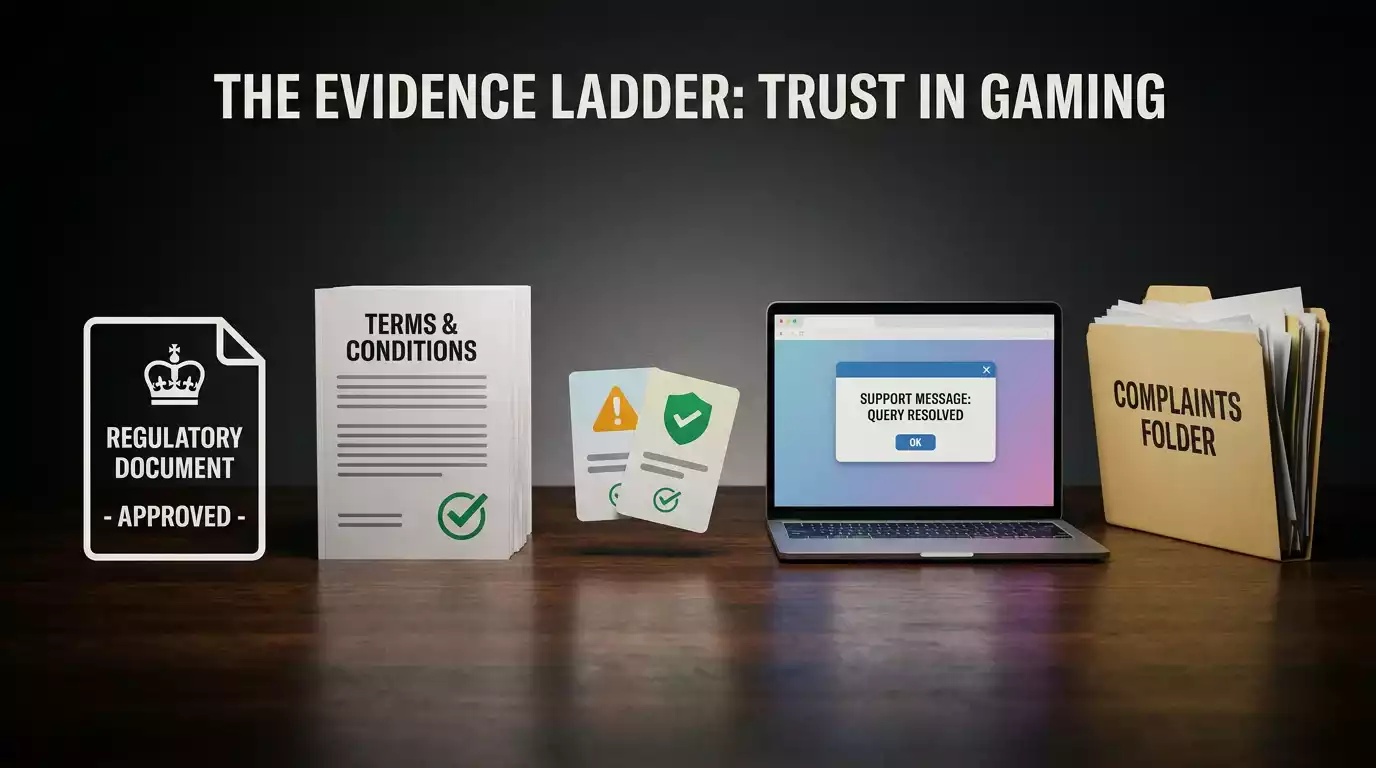
Reputation signals carry different weight. An official regulator record can settle a question; a current operator terms document can settle a different question; a third-party safety service is a risk indicator; a user review is contextual. For FatBet, each layer answers a different part of the trust picture, and treating any single layer as the whole answer is the most common evaluation mistake.
| Source layer | What it can settle | FatBet status |
|---|---|---|
| UKGC public register | Licence existence, operator identity, activity type, current status. | No current match located in this research. Re-check live before any decision. |
| Regulator enforcement records | Whether the operator has been subject to GB regulatory action. | No matched enforcement notice for FatBet specifically. |
| Live operator terms and footer | The legal operator name, address, licence claim and complaint route. | Read the live document at the time of any account decision. |
| Third-party safety services | Aggregated risk signals from documented complaints and structural checks. | Casino Guru low safety score; Chipy blacklist mention; both treated as risk signals, not verdicts. |
| Industry profiles and review pages | Catalogue, payment and bonus context; not licence proof. | Use as leads; do not treat catalogue claims as licence confirmation. |
| User reviews and forum posts | Patterns of disputes, withdrawal experiences and support behaviour. | Useful only with dates, amounts, methods and document evidence; weigh accordingly. |
Third-party safety and complaint signals
Two third-party services account for the most visible negative signals in this research. Casino Guru published a low safety score for FatBet, and the underlying review references concerns about terms and complaint handling. Chipy lists FatBet on a blacklist and refers to complaint history and lost contact. Each is a documented warning from a third-party service that aggregates structural and complaint-based signals across many operators.
Attribution matters. A low safety score is the third-party service’s editorial position; a blacklist entry reflects the listing service’s policy; neither is a Gambling Commission decision and neither alone establishes that the brand has been formally sanctioned. UK readers should still treat both as practical risk signals because they reflect aggregated patterns rather than a single user’s complaint. The point is to use them as input to a deposit decision, not as the final word.
Our top casino picks for the UK
- SpinFormulaBonus: 550% Up To £15,000 + 550 FS · Payout speed: 1-3 business days
- NightLuckBonus: Welcome Pack + 805% Up To 6400€ + 280 FS · Payout speed: 1-3 business days
- Revery PlayBonus: 100% up to€1,000+ 100 FS · Payout speed: 1-3 business days
- WinBeastBonus: €5000 + 500 FS + €650 Freebet · Payout speed: 1-3 business days
- EvoSpinBonus: 125% up to €2500 + 125 Free Spins · Payout speed: 1-3 business days
- ZombillionBonus: Welcome Pack 250% up to £4000 + 200 FS · Payout speed: 1-3 business days
- JetsetspinsBonus: 200% Bonus + 100 Free Spins + Free Royal Wheel · Payout speed: 1-3 business days
- BritsinoBonus: Welcome Package – Get your £2,200 + 2,000 FS · Payout speed: 1-3 business days
- BeOnBetBonus: 100% up to €500 + 100 FS · Payout speed: 1-3 business days
- ChanzeBonus: Slots Welcome Bonus #1 200% up to €500 · Payout speed: 1-3 business days
UKGC and legal trust checks
The most consequential trust check is the licence. A current UKGC remote-casino licence carries enforceable consumer protections: customer interaction obligations, KYC rules, advertising restrictions, complaint-handling expectations and access to alternative dispute resolution through a Commission-approved provider. A casino without a verified GB licence cannot offer those protections, and the deposit relationship sits outside the GB enforcement perimeter.
For FatBet, this is the single largest reason for caution. The dedicated FatBet licence checks page covers the regulatory layer in detail, and the UK availability matrix separates licence status from operational acceptance. Without a register match, the safer reading is that FatBet should be treated as outside the GB framework for any UK consumer-protection question.
Withdrawal and KYC risk signals
Trust problems most often surface at withdrawal. The pattern in many complaint records is that deposits and play proceed smoothly, then withdrawal triggers KYC, document re-requests, processing delays or bonus-related deductions that the player did not anticipate. For UK readers checking FatBet, withdrawal hygiene is therefore part of the safety question, not a separate topic.
Three signals matter most in advance. The first is whether withdrawal rules are visible and complete before depositing: minimums, maximums, fees, pending periods, method matching and document requirements. The second is whether KYC is triggered at registration rather than only at withdrawal; pre-deposit KYC is a stronger consumer signal than post-bet KYC. The third is whether support can point to where specific terms are written in the live document. The withdrawal due diligence page covers the operational steps.
Support, domain and operator consistency
Support behaviour and operator identity are often overlooked safety checks. A reachable live chat that answers specific term-location questions is a useful consumer signal. A support route that defers, deflects or asks for documents through a channel not linked from the live site is the opposite. For FatBet, support depth and channel verification were not directly confirmed in this research, so UK readers should test the live channel before any deposit.
Domain and operator consistency are equally important. The live domain in the browser, the operator name in the terms and the licence holder on the register need to agree. If the brand appears to operate from different domains, references different operators across pages, or names a licence number that does not appear on the public register, the consumer signal is poor regardless of catalogue or bonus headlines.
Safer gambling and GAMSTOP context
Safer-gambling language has a specific UK framing. GAMSTOP is a free national online self-exclusion service that helps people block access to gambling accounts on websites and apps licensed in Great Britain. The strongest safer-gambling environment for a UK reader is a GB-licensed operator whose tools, customer interactions and self-exclusion linkage are part of an enforceable compliance regime.
FatBet’s brand-specific safer-gambling tools were not safely verified from canonical official text. This guide does not promote non-GAMSTOP or offshore workarounds, does not present self-exclusion bypass as a feature, and does not frame a casino reach from outside the GB system as a “non-GAMSTOP advantage”. For UK readers using protective routes, the GAMSTOP and safer gambling page explains the boundary.
Practical FatBet safety checklist
- Search the UKGC public register for FatBet, FatBet Casino, the live domain and any operator name shown in the live terms.
- Read the live FatBet Terms and Conditions in full. Look for the operator name, address, licence claim, country eligibility, complaint route and ADR provider.
- Confirm whether the live cashier displays GBP for a UK selection and whether the available methods align with the GB credit-card rule.
- Treat the Casino Guru and Chipy signals as risk signals, not as verdicts. If similar concerns appear in newer third-party records, the risk weight goes up.
- Test live chat with a specific question: where in the live document is the withdrawal pending period written? An evasive answer is itself a signal.
- Have ID, proof of address and proof of payment-method ownership ready before depositing; pre-uploading documents reduces friction if KYC is triggered.
- Use the FatBet complaints guide for the warning-sign checklist before any account commitment.
What would improve the trust picture
The picture would improve if a current UKGC register entry clearly matched the FatBet domain, trading name and operator; if current terms clearly named UK or Great Britain in eligibility; if cashier and withdrawal rules were visible before deposit; if responsible-gambling tools could be verified from canonical official pages; and if support gave consistent answers tied to written terms. A clear complaint route through a Commission-approved ADR provider would close the largest open trust gap.
Until those pieces are verified, the sensible position is evidence-limited. FatBet may have casino content, games and mobile-browser access signals, but trust for a UK reader depends on regulated status, account eligibility, fair terms, transparent withdrawals and reliable support. A safety reading that skips those checks is not giving the reader enough information for a deposit decision.
Decision matrix for different readers
| Reader situation | Practical stance | Where to read next |
|---|---|---|
| Looking for a confirmed UKGC casino | FatBet did not meet the evidence standard. Choose a casino with a verified UKGC register match. | FatBet licence checks for the verification framework. |
| Trying to understand the brand | Use this guide as a due-diligence map; do not deposit until the licence question is settled. | FatBet UK review for the wider context. |
| Following a third-party bonus headline | Treat the headline as unconfirmed. Read live bonus terms and check country eligibility before opting in. | FatBet complaints guide for the warning-sign checklist. |
| Concerned about a withdrawal already requested | Document everything; read the live terms; escalate through any named ADR; do not deposit more. | withdrawal due diligence for the documentation checklist. |
| Self-excluded or trying to stop gambling | Do not search for a route around self-exclusion at FatBet or elsewhere. | GAMSTOP and safer gambling for support routes. |
Frequently asked questions
Is FatBet Casino safe?
The safer reading is high-caution. UKGC licensing was not verified, operational UK availability was not confirmed, and third-party services have published warnings. Those points do not prove every possible negative claim, but together they justify careful checks before any deposit.
What does the Casino Guru rating mean?
Casino Guru’s rating is the service’s editorial position based on its structural checks and complaint data. It is a third-party signal, not a regulator decision. Read it as a risk indicator and confirm specific concerns against the live FatBet terms.
Is FatBet blacklisted?
Chipy lists FatBet on a blacklist with references to complaints and lost contact. A listing service’s blacklist is its policy decision; it is a strong third-party signal but not a regulator sanction.
Has the Gambling Commission acted against FatBet?
No specific Commission enforcement notice naming FatBet was matched in this research. The unresolved licence question remains the more important issue for UK readers.
Is non-GAMSTOP access a benefit?
No. This guide does not present non-GAMSTOP or offshore access as a benefit. GAMSTOP is a protective tool. Routes around it are warning signs, not features.
What should I do if a FatBet withdrawal is delayed?
Document the timeline, the requested documents and the support exchanges. Read the live terms for pending periods. Escalate through any named ADR. The FatBet complaints guide covers the escalation steps.
Published by the Fatbet Casino team.