 Available in US
A FatBet UKGC licence was not matched during research. UK readers should rely on the Gambling Commission public register and the current site terms rather than affiliate or review-page claims.
Is FatBet Casino UKGC licensed?
This research did not match FatBet to any current UK Gambling Commission licence record. That is not the same as proof of absence: the public register is updated, and operator details can change, so a live recheck remains the only reliable answer. What it does mean is that this page cannot describe FatBet as UKGC-licensed, locally authorised in Great Britain, or covered by the regulator’s consumer protections that apply to GB-licensed remote casinos. Until a current register entry and the operator name in the live FatBet terms agree, the licence question stays open.
Great Britain-facing remote gambling is regulated. Operators that provide remote gambling facilities to consumers in Great Britain need the appropriate Gambling Commission licence, including businesses based outside Great Britain. The licence covers activity type, software supply where relevant, advertising and customer protection obligations. A casino brand without a current GB licence cannot legally accept GB customers for remote gambling, regardless of whether the website is reachable.Evidence position at a glance
UKGC licenceNo current Gambling Commission register entry for FatBet was matched in this research.Operator identitySources disagree on the exact operating company; the page does not state a definitive operator.Domain matchfatbetcasinos.com appears in casino references, but a register-linked domain match was not confirmed.GB legal statusWithout a verified UKGC licence, the brand should not be described as legal for GB remote gambling.
What the GB licensing rule means
The licensing rule is set out in the Gambling Act 2005 and applied by the Gambling Commission. Remote casino, betting and bingo activity offered to consumers in Great Britain falls under the requirement to hold a current Commission licence. The rule is anchored to the consumer being in Great Britain, not to the operator’s country of registration. A casino site hosted overseas still needs a GB remote licence to offer services to British residents.
Three practical consequences follow. First, a GB-licensed operator must comply with the Commission’s licensing conditions and codes of practice, including responsible gambling, customer interaction, KYC and advertising rules. Second, a GB-licensed operator must offer alternative dispute resolution and abide by GB consumer-protection rules in any complaint. Third, the Commission can publish enforcement actions, suspensions or licence revocations against licensed operators on its public records, which is itself a useful signal for a reader.
An operator that is not on the register cannot offer those protections to a GB consumer. That is the practical reason why the FatBet licence question matters more than bonus headlines or game-library claims.
UK, Great Britain and Northern Ireland wording
Search demand says “UK casino” or “UK licensed”, but the Gambling Commission’s remote licensing framework is built around Great Britain — that is, England, Scotland and Wales. Northern Ireland has separate provisions for some categories of gambling, and remote gambling supplied to Northern Ireland customers may sit outside the same regulatory mechanism. For most online-casino questions in this review, the Commission’s remote-licensing rule and the consumer protections it implies are framed as GB-facing.
For a reader, the distinction is operational. If you are checking whether a casino is appropriate for your account in England, Scotland or Wales, the relevant question is “GB-licensed”. If you are in Northern Ireland, the legal context can vary by product, and additional caution is warranted. This guide uses “UK” for reader intent and “Great Britain” for the regulatory mechanism, and it does not stretch a GB-focused statement into a blanket UK conclusion.
How the licence, trading name and domain checks fit together
An operator may trade under a brand that is not the same as the legal company name. The register holds the legal account holder and lists trading names, activities and licence status separately. That is why a thorough check pulls in at least four identifiers: brand name, legal operator name as shown in the live terms, domain name and licence account number.
For FatBet specifically, the brand visible on located casino pages is “FatBet” or “FatBet Casino”. The exact operating company name should be read in the live terms and footer of the casino site at the time of the check, not assumed from a third-party profile. The domain referenced in industry sources is fatbetcasinos.com, but a domain mention is not a licence. Cross-referencing the legal operator name to the register is the step that converts a brand reference into a verified licence answer. The dedicated UKGC register check page covers that workflow step by step.
Weak signals that should not decide the licence question
| Signal | What it actually shows | Decision impact |
|---|---|---|
| English-language site | The brand can be read by UK users. | None. Many offshore casinos serve English speakers without a GB licence. |
| GBP mention in a review | A reviewer has seen UK Pounds linked to the brand. | Low. GBP support does not confirm a UKGC licence or GB account acceptance. |
| Affiliate badge or logo | A marketing asset is displayed on a third-party page. | None. Badges are not the regulator’s records. |
| “Licensed” wording in a review snippet | Editorial text claims a licence exists. | Low. Confirm against the public register before treating it as fact. |
| Curaçao or other foreign licence reference | The brand may hold an offshore licence in another jurisdiction. | Does not answer the GB question. A non-UKGC licence is not a GB licence. |
What to check before relying on any FatBet licence claim
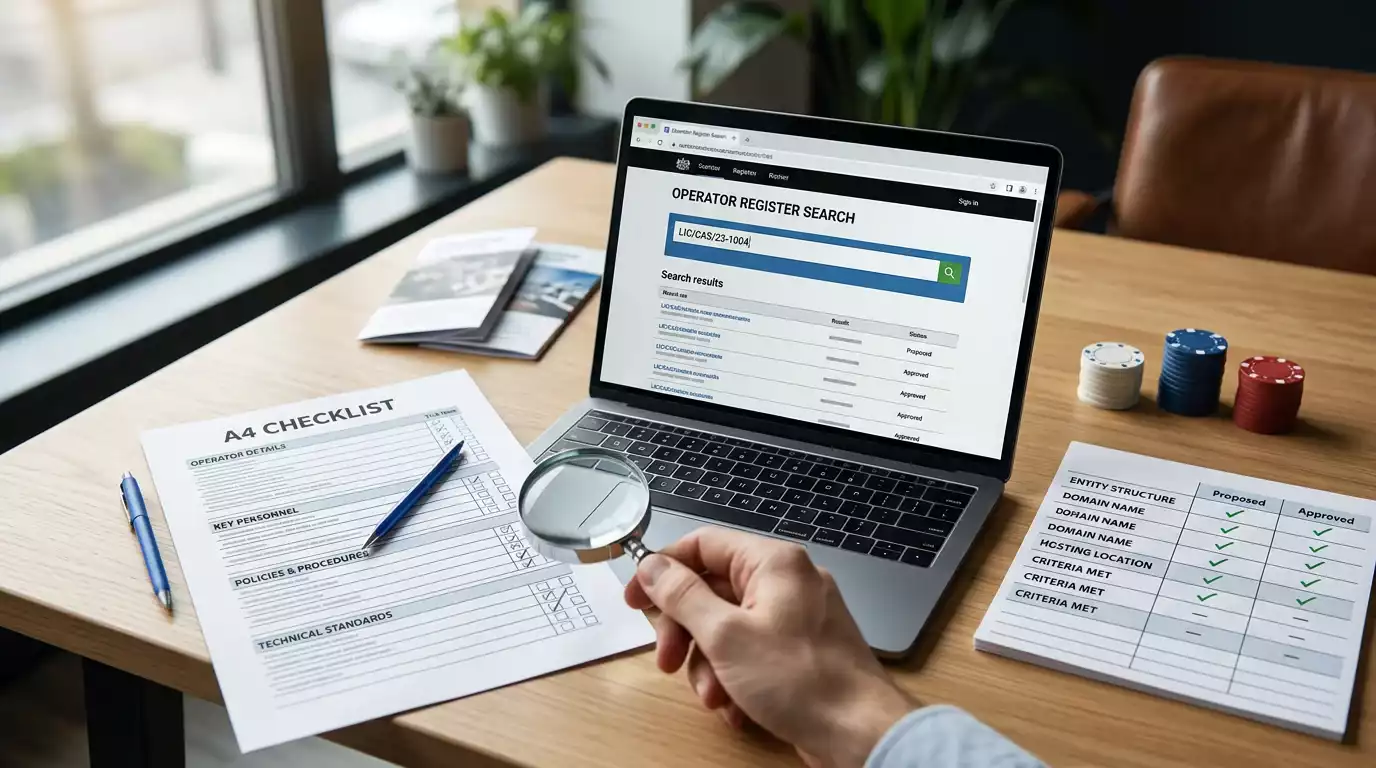
- Open the Gambling Commission public register and search by FatBet, FatBet Casino, the live domain and any operator name displayed in the live terms.
- Match the result by activity type — remote casino — and by current licence status, not by a closed or surrendered record.
- Compare the legal account holder in the register to the operator name in the live FatBet terms and footer. Names must agree, not be merely similar.
- If the register search returns nothing relevant, do not assume the brand “is” or “is not” licensed. Mark it as unresolved and pause any account or deposit action.
- If the brand publishes an offshore licence number, treat that as separate from the GB question; an offshore licence does not transfer GB consumer protections.
- Re-check after any material change in the brand: redirected domain, renamed operator, new payment methods or a fresh promotion. Each of those can affect the register match.
Why an unverified licence is not the same as a banned operator
Two outcomes are often confused. The first is “verified UKGC-licensed” — the brand and operator appear on the register with an active remote-casino licence. The second is “verified ineligible for GB” — visible official general-account text bars GB residents from the service, or the regulator has published enforcement information naming the brand. This research produced neither outcome for FatBet. No current register match was confirmed, and no strict official hard-stop naming the UK or GB as generally barred was validated either.
The honest reading is “unresolved”. UK readers should not deposit on the basis that the brand might be licensed; that is the same as depositing without checking. UK readers should also not assume FatBet is universally blocked from GB accounts, because the available evidence did not show that either. The safer behaviour is to verify the register and the live terms before any registration, deposit or bonus action.
How this affects the rest of the review
Because the licence question is not resolved, every downstream claim has to carry a caveat. Payment lists cannot be promoted as GB-compliant cashier routes. Bonus headlines cannot be republished as current UK offers. Withdrawal speed claims cannot be turned into expectations. KYC language cannot be reduced to “smooth onboarding”. Customer-protection promises depending on UKGC enforcement cannot be assumed.
The corresponding deep pages handle each downstream area separately. The UK availability matrix separates account access from licence status. The UK gambling winnings tax page explains the player-tax position without using “tax-free” as a safety claim. The FatBet payment checks page covers the GB credit-card rule and cashier verification. For trust and complaint context, see the FatBet safety review and the GAMSTOP and safer gambling guide.
Frequently asked questions
Is FatBet on the UK Gambling Commission register?
This research did not match FatBet to a current register entry. The reliable answer is to search the public register at the time of any account decision, using the brand, domain and any operator name shown in the live FatBet terms.Can FatBet legally accept UK players without a UKGC licence?
Operators that offer remote gambling to consumers in Great Britain must hold the appropriate Gambling Commission licence, regardless of where the operator is based. Without a current GB licence, GB consumer protections do not apply.Does a Curaçao licence cover UK players?
No. An offshore licence in another jurisdiction does not provide a UK Gambling Commission licence, and it does not transfer GB consumer protections, complaint routes or advertising rules.What if a review page calls FatBet “UK licensed”?
Treat the claim as unconfirmed unless the page cites a current Gambling Commission register entry that matches the live domain and the legal operator. Affiliate or summary pages can repeat marketing language that is no longer accurate.Should I search for both “FatBet” and “FatBet Casino” on the register?
Yes. Trading names can differ between casual marketing and the registered company. Use both forms, the live domain and any operator name printed in the casino terms before concluding a search.
Privacy Policy | Cookie Policy | About This Guide
See also: visit fatbet casino for fully licensed UK casino options.
See also: understand tax implications in our gambling tax guide.
Created by the "FatBet UK Guide" editorial team.